
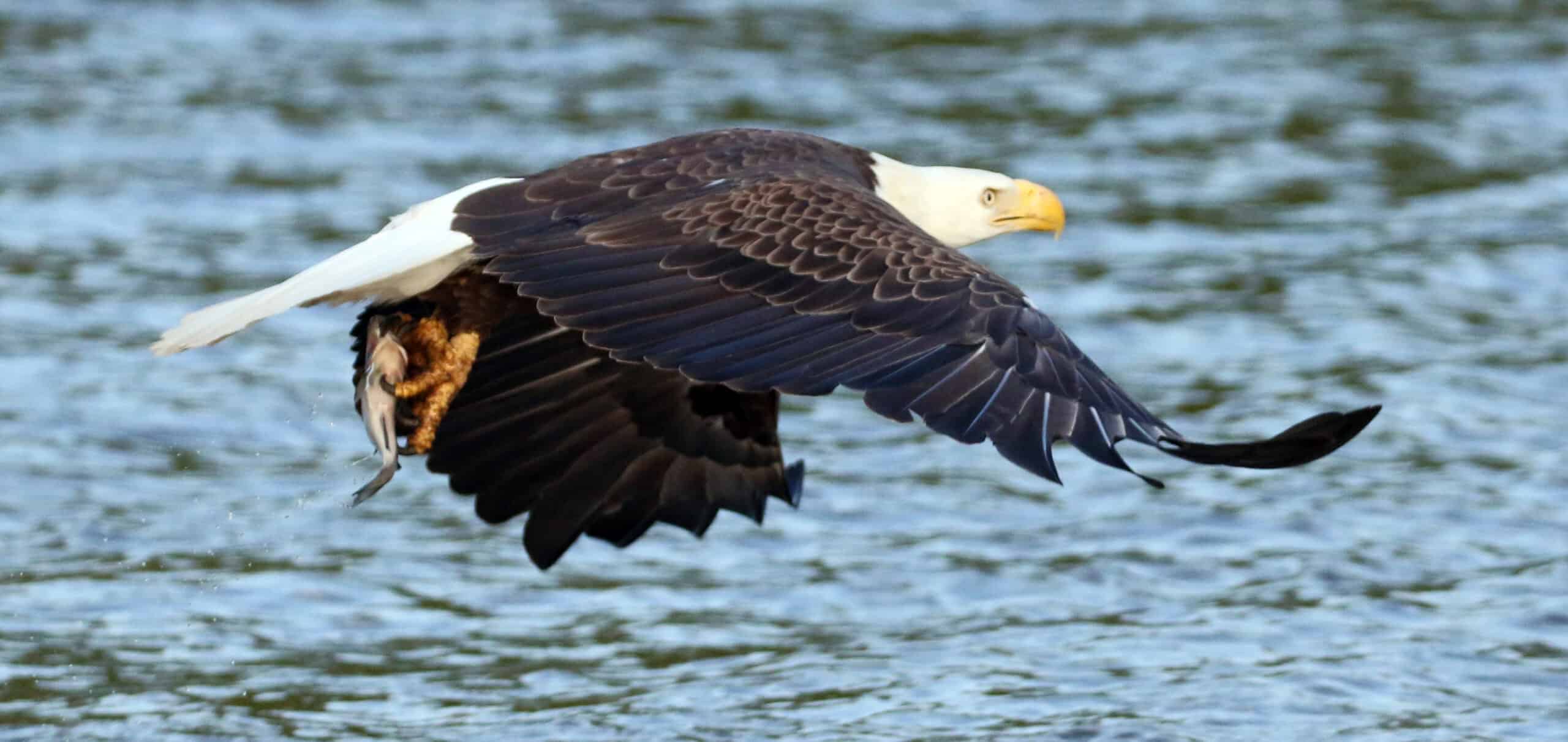
There are few things as majestic as a Bald Eagle soaring across the sky. These powerful predators weigh less than 15 pounds and can have wingspans up to 7 ½ feet. Native to the Shenandoah Valley, their dark brown and white bodies make them easy to identify and observe in the South River Watershed today. But that wasn’t always the case. From 1936 to 1974, the total number of known Bald Eagle nesting pairs in the Valley decreased from about 150-200 to zero. Two actions in the early 1970s changed that trajectory. In 1972, the Environmental Protection Agency banned almost all use of DDT (dichlorodiphenyltrichloroethane). DDT was an insecticide that weakened the eggshells of Bald Eagles, making them more likely to break and resulting in fewer hatchlings. In 1973, President Nixon signed the Endangered Species Act. The act allowed the Virginia Department of Wildlife Resources to protect Bald Eagle nesting and roosting sites, which helped the population recover. Fast forward 50 years and known Bald Eagle pairs in Virginia number over 1,000. The species is no longer endangered—it is thriving. In the Chesapeake Bay Watershed, there are 3,000 new breeding pairs. Want to get a peek at these powerful, high-flying fowl? Look for them high above the trees along the South River or near any bodies of water in Augusta County or open fields. There are records of several nesting pairs in Augusta County